Commercial Vehicle Glove Compartment Organization (2026)
The glove compartment in a commercial vehicle is rarely just for gloves. For many drivers, it becomes the catch-all for paperwork, pens, charging cables, spare fuses, receipts, sunglasses, and whatever else gets tossed in during a busy shift. The problem is that ?catch-all? quickly turns into ?can?t-find-anything,? especially when you?re working in a van, pickup, box truck, or fleet vehicle where time and professionalism matter.
A well-organized glove box isn?t about being neat for the sake of it. It?s about speed, safety, and reliability. When a warning light comes on and you need the owner?s manual fast, when an inspector asks for registration, or when you?re hunting for that spare phone mount clip at a customer site, a tidy glove compartment saves minutes?and prevents stress.
This guide walks you through a practical, commercial-vehicle-friendly glove compartment organization system. You?ll get a step-by-step process, recommended organizers and pouches, common mistakes to avoid, and a setup that stays tidy even if multiple drivers share the same vehicle.
Why Glove Compartment Organization Matters in Commercial Vehicles
Commercial vehicles live a harder life than most personal cars. Tools, work orders, delivery slips, and daily clutter can overwhelm small storage areas quickly. A structured glove compartment setup provides real benefits:
- Faster access to critical documents during roadside stops, inspections, or job check-ins.
- Reduced distractions because you?re not digging around while parked at the curb?or worse, while rolling slowly in traffic.
- Less wear and tear on hinges and latches caused by overstuffing.
- Cleaner interior presentation for customer-facing work (service vans, real estate, chauffeurs, mobile technicians).
- Improved fleet consistency when several people drive the same truck or van.
Know Your Glove Box: Common Commercial Vehicle Layouts
Before buying organizers, take a moment to understand what you?re working with. Commercial vehicles often differ from passenger cars in a few key ways:
1) Standard glove compartment (drop-down door)
Most pickups and vans use the classic drop-down glove box. It?s great for flat items, but things slide around unless contained.
2) Dual glove boxes (upper + lower)
Some vans and work trucks offer an upper shelf-style compartment and a lower drop-down. This is ideal for separating frequently used items from ?emergency only? items.
3) Locking glove compartments
Common in fleet vehicles and some trims. Useful for securing documents, but don?t assume it?s a safe?treat it as ?discourages casual access,? not theft-proof storage.
4) Glove box with built-in dividers/pen slots
Nice in theory, but many built-in dividers are shallow and not sized for real-world work items like multi-page forms, larger manuals, or thicker pouches.
Step-by-Step: Set Up a Glove Compartment That Stays Organized
Step 1: Empty it completely and clean it
Remove everything, including crumbs, coins, old receipts, and expired paperwork. Wipe down the interior with a microfiber cloth and a mild interior cleaner. If there?s a musty smell, a light interior-safe disinfectant wipe can help.
- Check for sticky residue from hand sanitizer or spilled drinks.
- Look for water intrusion (damp papers, mildew smell). If present, address the leak before restocking.
Step 2: Sort into four ?use levels?
This is the easiest way to prevent glove box overload. Make four piles:
- Legal/required: registration, insurance, inspection documents, permits.
- Frequent-use: flashlight, tire pressure gauge, spare charging cable, notepad, pens.
- Emergency-only: spare fuses, small first-aid items, emergency contact list.
- Remove from glove box: tools, thick manuals you never open, stacks of receipts, loose hardware.
Real-world example: A courier van driver often keeps delivery slips in the glove box. Better: keep only a small ?current route? packet up front, and move completed paperwork to a folder in the door pocket or a center console bin to avoid mixing old and new.
Step 3: Measure your glove compartment
Grab a tape measure (or use your phone?s measuring app) and note:
- Width (side to side)
- Depth (front to back)
- Height clearance when closing
- Any intrusions (airbag modules, hinges, dampers)
Measurements prevent buying an organizer that blocks the latch or causes the door to bulge.
Step 4: Choose a containment system (pouches beat loose stacks)
For commercial vehicles, the most reliable setup is a ?pouch system? instead of stacking papers and small items directly in the compartment. Aim for:
- One slim document wallet for legal/required papers
- One small zip pouch for frequent-use gear
- One micro emergency pouch for fuses and tiny spares
This keeps items from migrating and makes glove box access simple: pull the pouch you need, zip it back up, return it.
Step 5: Assign zones inside the glove compartment
Even a small glove box can have zones. Use this simple layout:
- Front/top (quick grab): pen, flashlight, tire gauge, charging cable
- Middle: document wallet (registration/insurance)
- Back/bottom (rarely used): emergency pouch, spare fuses, small spare bulbs (if applicable)
If you have an upper glove compartment, put frequent-use items up top and legal documents down below to reduce the chance of papers getting bent or exposed.
Step 6: Add a ?paper control? rule for work receipts and forms
Paper is the number-one reason glove boxes become unmanageable. Set a strict rule:
- No loose receipts in the glove compartment.
- Use a small envelope or mini expanding file and empty it weekly.
- If your job produces lots of paperwork, keep a clip folder or accordion file elsewhere (door pocket, behind-seat organizer, or center console), not in the glove box.
What to Keep in a Commercial Vehicle Glove Compartment (Checklist)
Use this as a baseline. Adjust for your region, company policy, and vehicle type.
Must-haves (most drivers)
- Registration and insurance (in a document wallet)
- Owner?s manual (or quick reference guide)
- Small flashlight (compact LED)
- Pen + permanent marker (for jobsite labeling)
- Microfiber cloth (for quick windshield/eyewear wipe)
Work-friendly additions
- Spare phone charging cable (short, durable, braided if possible)
- Tire pressure gauge (simple pencil style or compact digital)
- Nitrile gloves (2?4 pairs in a zip bag)
- Small notepad or pre-printed inspection checklist
Emergency-only (keep small)
- Spare fuses (in a labeled mini case)
- Small first-aid basics (bandages, antiseptic wipes)
- Emergency contact card (especially for fleet drivers)
Tip: Store bulky safety items like triangles, a full first-aid kit, jumper cables, and tow straps outside the glove compartment?under-seat storage, rear bin, or cargo area makes more sense.
Organizer and Product Recommendations (What Works Best)
You don?t need brand-name everything, but you do need the right type of organizer. Here are proven options for commercial vehicle glove compartment organization.
Document wallets: best for registration and insurance
- Slim PVC or PU leather document holder: Water-resistant, easy to wipe clean, keeps papers flat.
- Expanding document wallet (thin): Useful if you carry multiple permits, but choose a low-profile version to avoid bulging the glove box.
Look for: A5/A4 compatibility (depending on your paperwork), rigid panels to prevent curling, and a secure snap or zipper.
Zip pouches: best for small gear that otherwise gets lost
- Nylon zip pouch with internal mesh pockets: Great for cables, adapters, a small flashlight, and gloves.
- Clear zip pouch: Faster to identify contents, especially in shared vehicles.
Look for: Smooth zipper, reinforced seams, and a size that fits with the glove box closing freely.
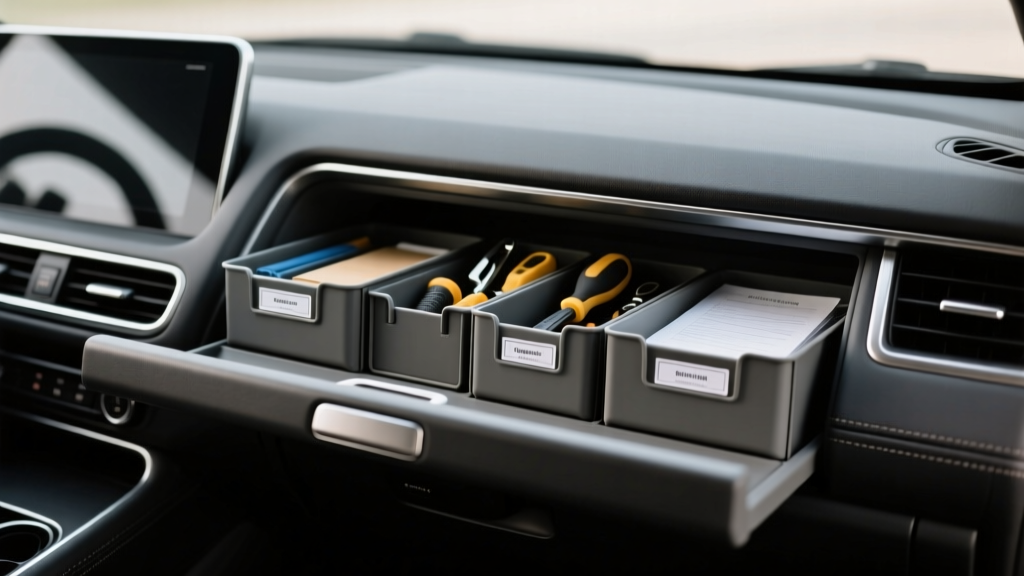
Small compartment trays: best when your glove box is deep
- Universal glove box organizer tray: Helps separate pens, coins (if needed), and small items.
- DIY tray using a cut-to-fit drawer organizer: Works well for odd-shaped glove boxes.
Watch out for: Trays that slide forward and jam the door. If it shifts easily, add thin grip liner underneath.
Grip liner: the low-cost fix that makes everything better
- Non-slip shelf liner (thin): Prevents pouches and wallets from sliding during stops and turns.
Quick comparison: pouch system vs. rigid divider system
- Pouch system: Flexible, works in any vehicle, easy to transfer between vehicles, best for fleets.
- Rigid dividers/trays: Cleaner look, faster for very small items, but often vehicle-specific and can waste space.
Commercial Vehicle Use Cases: Setups That Make Sense
Service van (HVAC, plumbing, electrical)
- Document wallet: insurance, registration, service agreement templates (a few only)
- Zip pouch: flashlight, marker, spare charging cable
- Emergency micro pouch: fuses + nitrile gloves
Extra tip: Keep customer invoices and job paperwork out of the glove box. Use a clipboard folder and store it between seats or in a door pocket for quick access.
Delivery driver (last-mile or courier)
- Upper glove box (if available): route notes, pen, parking receipts envelope
- Lower glove box: legal documents wallet + emergency pouch
Extra tip: Set a weekly ?receipt reset? day so parking/toll receipts don?t snowball.
Fleet pickup (multi-driver)
- Clear labeled pouches: ?Docs,? ?Daily,? ?Emergency?
- Add a printed inventory card listing what should be inside
Extra tip: Color-coding works: red for emergency, black for documents, gray for daily items.
Common Mistakes to Avoid
- Overstuffing the glove compartment: If it takes two hands to close, it?s too full. This can break latches and warp the door over time.
- Storing heavy tools inside: Tools belong in a secured toolbox, under-seat compartment, or cargo organizer?not near an airbag-equipped dash area.
- Mixing current paperwork with old receipts: This is how important documents get lost or damaged.
- Keeping originals without backups: Keep digital copies of insurance and registration where legal in your region (phone/cloud) so you?re covered if papers get wet or torn.
- Using organizers that block the glove box damper or latch: Test-fit before committing, especially with rigid trays.
- Ignoring heat and sun exposure: Some adhesives, cheap plastics, and batteries don?t love dashboard heat. Avoid storing spare lithium batteries in extreme temperatures.
Maintenance: Keep It Organized in 5 Minutes a Week
A glove compartment stays organized when it?s maintained like a tool, not treated like a junk drawer. Try this simple routine:
- Weekly: Remove loose papers, empty receipt envelope, wipe dust, confirm documents are present.
- Monthly: Check flashlight battery, review emergency pouch supplies, restock gloves and wipes.
- Quarterly: Update insurance/registration paperwork, purge outdated forms, inspect glove box hinge and latch.
Practical tip: Pair the weekly glove box check with a regular task you already do?fueling day, wash day, or end-of-week vehicle walkaround.
FAQ: Commercial Vehicle Glove Compartment Organization
What documents should always be in the glove compartment?
Most drivers keep registration and proof of insurance there, ideally in a slim document wallet. Depending on your location and job, you may also need inspection certificates, permits, or fleet ID cards. Keep them flat, protected, and easy to grab.
Is it safe to store valuables in a glove compartment?
Not really. Even a locking glove box is a deterrent, not a true safe. Avoid storing cash, expensive electronics, or sensitive customer data. For higher security, use a lockable center console safe or a secured storage solution in the cargo area.
How do I keep items from sliding around when driving?
Use a combination of non-slip shelf liner and zip pouches. The liner reduces movement, and the pouches prevent small items from scattering when you open the door.
What?s the best way to organize a glove compartment in a shared fleet vehicle?
Standardize the layout: labeled pouches (?Docs,? ?Daily,? ?Emergency?), an inventory checklist, and a simple rule that no one stores personal items inside. This keeps the glove box consistent from driver to driver.
Should I keep the owner?s manual in the glove box?
Yes, if it fits without bending or forcing the door shut. If the manual is thick and space is limited, keep a quick reference guide in the glove box and store the full manual elsewhere in the vehicle.
How do I handle work receipts and paperwork without cluttering the glove box?
Use a dedicated receipt envelope or slim folder, and empty it weekly. For high-volume paperwork, move to an accordion file stored in a door pocket, under-seat bin, or cargo area organizer.
Conclusion: Build a Glove Compartment System You Can Rely On
A commercial vehicle glove compartment works best when it has a job: hold the documents you must have, the small gear you reach for often, and a few compact emergency essentials?nothing more. Start by clearing it out, sorting by use level, and using a pouch-based organization system with a document wallet and non-slip liner. Once it?s set up, a five-minute weekly reset keeps it that way.
Next steps: measure your glove box, choose two or three slim organizers, label them if your vehicle is shared, and set a weekly reminder to empty receipts and check supplies. For more practical interior organization tips, storage ideas, and gear guides, explore the latest articles on carinteriormix.com.